


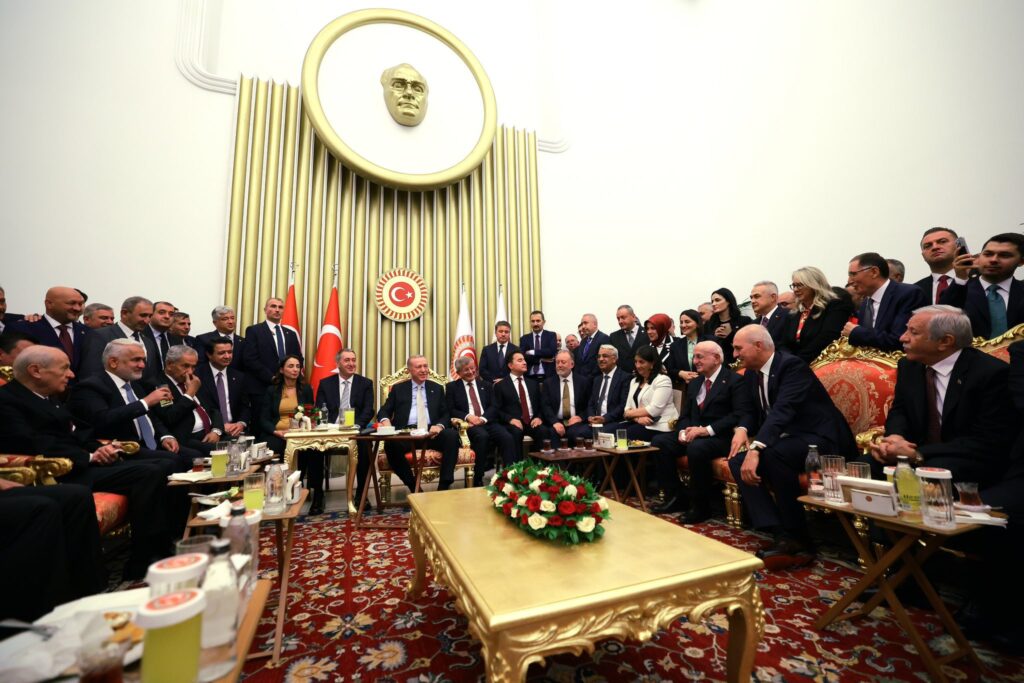
Several opposition leaders in Turkey faced a backlash after they joined President Recep Tayyip Erdoğan at a parliamentary session on Wednesday, crowding around his table, in what critics described as a photo-op granting legitimacy to the president’s one-man rule.
This came as the main opposition Republican People’s Party (CHP) and two left-wing parties boycotted the session marking the end of parliament’s recess, leaving their seats empty in protest of what they called the dismantling of the country’s constitutional democracy.
The new legislative year opened with Erdoğan laying out economic targets and promising reforms.
However, the spotlight was on who appeared beside him.
The CHP, Turkey’s oldest party and the victor of the 2024 local elections, stayed away, decorating its empty seats with flowers, in protest of what it called a yearlong campaign of arrests, investigations and seizures it says were aimed at crippling its leadership. The Workers’ Party of Turkey (TİP) and the Labor Party (EMEP) also boycotted the event, citing the erosion of the rule of law, pointing to the arrest of hundreds of CHP members and municipal officials, the stripping of MP Can Atalay of his seat despite top court rulings in his favor, and the jailing of opposition figures like Kurdish politicians Selahattin Demirtaş and Figen Yüksekdağ as well as philanthropist Osman Kavala.
CHP Chairman Özgür Özel said his party would not “add legitimacy to those who seek it abroad,” referencing comments by the US ambassador to Turkey, who said Erdoğan wanted American backing.
That boycott framed the criticism against other opposition leaders who chose to attend.
Erdoğan was pictured in a gilded parliament hall under the emblem of the Turkish Parliament, flanked by his ally, Nationalist Movement Party (MHP) leader Devlet Bahçeli and opposition figures such as pro-Kurdish Peoples’ Equality and Democracy Party (DEM Party) Co-chair Tuncer Bakırhan, Democracy and Progress Party (DEVA Party) leader Ali Babacan and Future Party leader Ahmet Davutoğlu, both former heavyweights of the ruling Justice and Development Party (AKP).
Nationalist opposition Good (İYİ) Party Chair Müsavat Dervişoğlu was also present earlier in the day.
For Erdoğan, analysts said, the optics were deliberate.
ABD gezisi sonrası prestiji sarsılan ve meşruiyeti tartışmaya açılan Erdoğan’a bugün CHP dışındaki bu muhalefet partileri adeta can simidi oldu. İktidar, meşruiyet krizinden çıkmak için bu fotoğrafa ihtiyaç duyuyordu. İktidara gelme umudu olmayan bu partiler, uzun soluklu… https://t.co/TTkFMtv8M7
— Berk (@berkesen) October 1, 2025
“These parties, with no hope of coming to power, prefer to bargain with Erdoğan rather than engage in a long-term opposition struggle,” Berk Esen, a political scientist at Sabancı University, posted on X.
Many journalists and analysts said opposition figures who posed with Erdoğan had “certified his power” instead of resisting it. The strongest criticism was directed at DEM Party lawmakers over their willingness to sit with Erdoğan while many of their own former leaders remain jailed, including Demirtaş and Yüksekdağ.
Siz niye ölçüyü tutturamıyorsunuz bir türlü?
Niye bu kadar "sivik"sınız, niye biraz "giran" olmak size ağır geliyor.
Bu kadar yaşanmışlıktan sonra Erdoğan'a böyle hayranlıkla bakmak, sırnaşmak, elini sıkmak için birbirini ezmek, böyle el pençe divan durmak…
Ne dostlukta, ne… pic.twitter.com/5y657WBsyO
— Sinan Aygül (@sinanaygul) October 1, 2025
“After all you have been through, to look at him with admiration, to fawn over him, to trample each other to shake his hand, to stand there like servants …” wrote Sinan Aygül, a Kurdish journalist, criticizing DEM Party lawmakers in a post on X.
“With your stance today, you have certified the power of His Majesty, and you no longer have the right to question his wisdom,” Aygül wrote.
2019 seçimlerinde Erdoğan sandığa oy kullanmaya gittiğinde çekilmişti bu fotoğraf.
Erdoğan oy kullanırken tam tersi yöne bakan ve gülümsemeyen Rukiye Şimşek tepkiler üzerine "Aynı karede hiçbir farkımız, sorunumuz yok gibi davranamazdım." demişti.
Her pozun bir anlamı vardır,… pic.twitter.com/Ca6fgyDTbs
— mahirgra (@mahir_gra) October 2, 2025
Another commentator recalled a viral 2019 election image of an official who refused to smile as Erdoğan voted — unlike her peers — arguing that “every pose has a meaning” in a country weary of political repression.
Political scientist Emrah Gülsunar also said the scene was no accident.
Bugün Erdoğan'ın CHP'yi yalnız gösterebilmek ve meşru olduğu mesajını verebilmek için mecliste kurguladığı mizansene koşa koşa gidip katılan tüm partiler rejimin kontrollü muhalefet partisidir. Putin rejimindeki Aliyev rejimindeki muhalefet partileri neyse onlar da odur.
— Emrah Gülsunar (@emrahgulsunar) October 1, 2025
“All the parties that eagerly took part in the staged photo orchestrated by Erdoğan to show the CHP as isolated and to project his legitimacy are controlled opposition parties,” he wrote on X. “They are no different from the opposition parties in [Russian President Vladimir] Putin’s regime or [Azerbaijani President Ilham] Aliyev’s regime.”
Since a failed coup in 2016 that led to a two-year emergency rule and Turkey’s subsequent shift to an executive presidential system in 2018, Erdoğan has amassed sweeping powers.
Courts have jailed tens of thousands including opposition leaders and ignored rulings from the Constitutional Court and the European Court of Human Rights (ECtHR).
Turkish “Pres” Erdoğan has significantly reshaped the country's government by replacing the parliamentary system with highly centralized presidential one. The changes have diminished the power of the parliament and judiciary while granting the president sweeping new authority. pic.twitter.com/8ESaJeNYqF
— Rachel Bitecofer 🗽🦆 (@RachelBitecofer) September 25, 2025
İstanbul mayor and CHP presidential contender Ekrem İmamoğlu was arrested in March 2025. Eleven CHP mayors have been jailed, others sidelined, and some opposition mayors chose to defect to the AKP. Prominent dissidents like Kavala, imprisoned since 2017, and Demirtaş, imprisoned since 2016, remain behind bars despite repeated ECtHR judgments.
Since last October, the government has pursued a two-track strategy of intensifying its crackdown on the CHP while courting the DEM Party and breakaway AKP factions as “acceptable opposition.”
By arresting his chief rival and splitting the left, Turkey’s president is seeking to create a pliant opposition that ensures his Justice and Development Party’s long-term dominance, Halil Karaveli writes. https://t.co/R3i5HWzAuO
— Foreign Policy (@ForeignPolicy) March 30, 2025
Bahçeli’s 2024 handshake with DEM Party deputies marked the start for later meetings with imprisoned Kurdistan Workers’ Party (PKK) leader Abdullah Öcalan, a cease-fire declaration by the Kurdish militants and even a symbolic weapons-burning ceremony. But while this “peace track” has generated headlines, jailed Kurdish politicians remain in prison and dismissed DEM Party mayors have not been reinstated.
For critics, the scene of opposition leaders posing with polite smiles next to Erdoğan stood in sharp contrast to the reality that many opposition politicians remain in prison.