
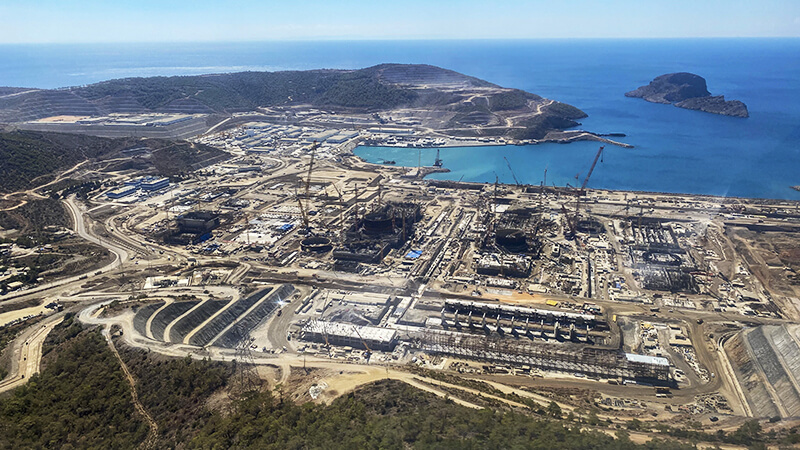

The first reactor of Turkey’s Akkuyu Nuclear Power Plant is moving toward its final commissioning stage, a senior company official said, but independent reports warn international sanctions on Russia are pushing back the timeline.
Sergey Butckikh, general manager of Akkuyu Nuclear JSC, told Turkey’s state-run Anadolu news agency in an interview on Sunday that system tests are underway to ensure safe operation. He said the unit would then be loaded with nuclear fuel and begin producing electricity.
“We are now conducting commissioning work. At this stage all equipment of the systems undergoes tests, their operations are checked and they are prepared for safe operation,” Butckikh told Anadolu.
“After commissioning activities in the first power unit, we will move to the start-up stage.”
The Akkuyu nuclear power plant is being built in Akkuyu, Mersin province, by Rosatom, Russia’s state nuclear company. The plant’s construction began in 2018.
The Warsaw-based Centre for Eastern Studies, however, reported in September that sanctions on Russian banks and supply chains due to Russia’s ongoing war on Ukraine have complicated financing and procurement. Although Rosatom is not directly sanctioned, restrictions have frozen billions of dollars in transfers through US banks and made international lenders wary of involvement.
To ease financing pressures, Ankara and Moscow arranged for Turkey’s state-owned energy company BOTAŞ to redirect payments for Russian gas into the Akkuyu project through domestic banks. While the move has kept funding flowing, it has not solved shortages of equipment once imported from Europe.
Turkish and international media have also cited delays in turbine deliveries from Germany’s Siemens company.
A Siemens Energy spokesperson told Deutsche Welle Turkish edition in September 2024 that while some electrical equipment had been delivered earlier, further shipments have been suspended for about a year due to missing export and customs permits.
“As a company, we are obliged to comply with export regulations,” the spokesperson said, referring to German government restrictions.
In Germany, the Federal Office for Economic Affairs and Export Control issues export licenses under the oversight of the Federal Ministry for Economic Affairs and Climate Protection.
In some cases Rosatom has reportedly turned to Chinese suppliers, though those claims have not been confirmed. Speculation has also grown that Rosatom may seek to sell up to 49 percent of the project to investors from China, India or the Middle East, but no deal has been announced.
Officials say that all four 1,200-megawatt reactors will be online by 2028. Analysts caution, however, that financial and logistical hurdles put that goal at risk. Once completed, Akkuyu is expected to supply about 10 percent of Turkey’s electricity demand. But with the original 2023 deadline already missed, experts say commercial production before 2026 appears unlikely.