
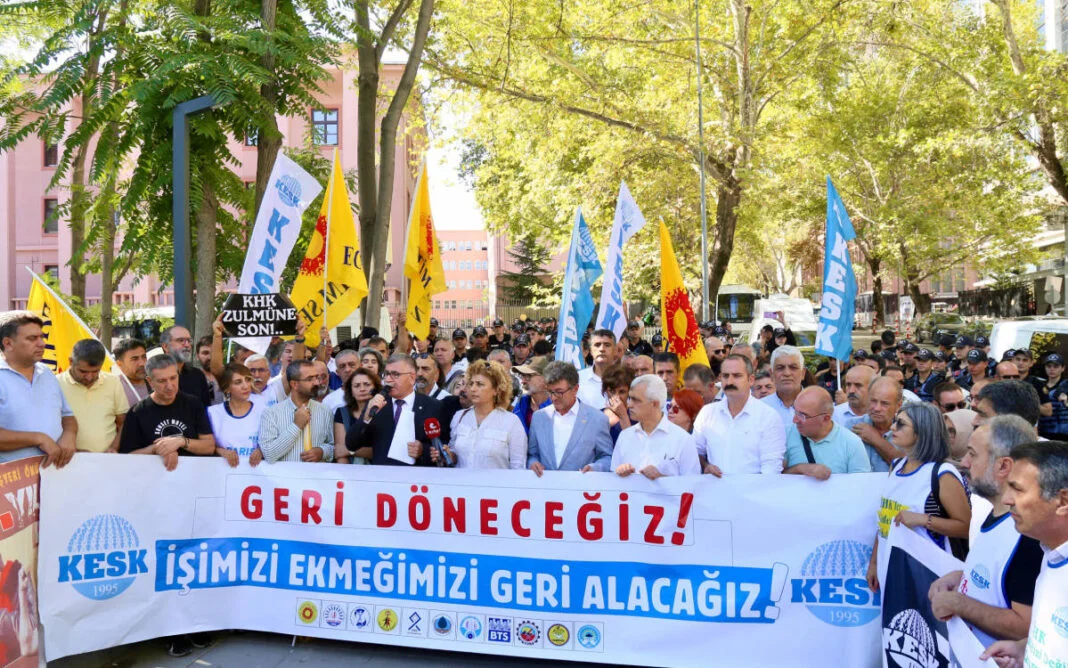
 on Monday called for the reinstatement of civil servants dismissed by emergency decrees during a post-coup purge in Turkey, delivering a press statement outside the Justice Ministry in #Ankara.)
The Confederation of Public Employees’ Trade Unions (KESK) on Monday called for the reinstatement of civil servants dismissed by emergency decrees during a post-coup purge in Turkey, delivering a press statement outside the Justice Ministry in Ankara, the Stockholm Center for Freedom reported.
KESK Co-Chair Ahmet Karagöz said that although seven years have passed since the lifting of a state of emergency imposed following a coup attempt in 2016 and three years since the expiration of the mandate of the OHAL Commission, set up to adjudicate the cases of civil servants who were fired following the failed coup, emergency rule practices remained effectively in place. He added that KESK members were expelled simply for standing up for rights and freedoms.
Karagöz was joined by human rights defender and Peoples’ Equality and Democracy Party (DEM) lawmaker Ömer Faruk Gergerlioğlu as well as Yüksel Taşkın from the main opposition Republican People’s Party (CHP).
In the aftermath of an abortive putsch on July 15, 2016, the Turkish government declared a state of emergency and carried out a massive purge of state institutions under the pretext of an anti-coup fight. More than 127,000 people were summarily dismissed from the civil service. Fewer than 20,000 have been reinstated through the OHAL Commission.
Karagöz called on parliament’s Commission on National Solidarity, Brotherhood and Democracy to take urgent measures to reinstate dismissed KESK members. The commission was established in August as part of a government initiative to oversee legal and political reforms linked to the outlawed Kurdistan Workers’ Party’s (PKK) decision in May to disarm. His appeal came as the commission held its fifth meeting on Wednesday.
Gergerlioğlu, himself a dismissed public servant, said the purge had turned into a “civil genocide,” leaving citizens hopeless and pushing many into exile.
CHP lawmaker Taşkın criticized Justice Minister Yılmaz Tunç for refusing to meet with KESK representatives, describing him as “incompetent and unqualified.”
Former civil servants were not only fired from their jobs; they were also prohibited from working again in the public sector and getting a passport. The government also made it difficult for them to work formally in the private sector.
The post-coup crackdown mainly targeted followers of the Gülen movement, a faith-based group inspired by the late Muslim cleric Fethullah Gülen, whom the Turkish government accused of orchestrating the abortive putsch.
The crackdown also targeted political opponents of the government, Kurdish activists and human rights defenders, among others. Gülen and the movement strongly denied involvement in the abortive putsch or any terrorist activity.
Some purge victims who wanted to flee the country to avoid the post-coup crackdown and took dangerous journeys across the Evros River in northwestern Turkey or the Aegean Sea perished on their way to Greece. They had to leave the country illegally due to the lack of valid passports.