


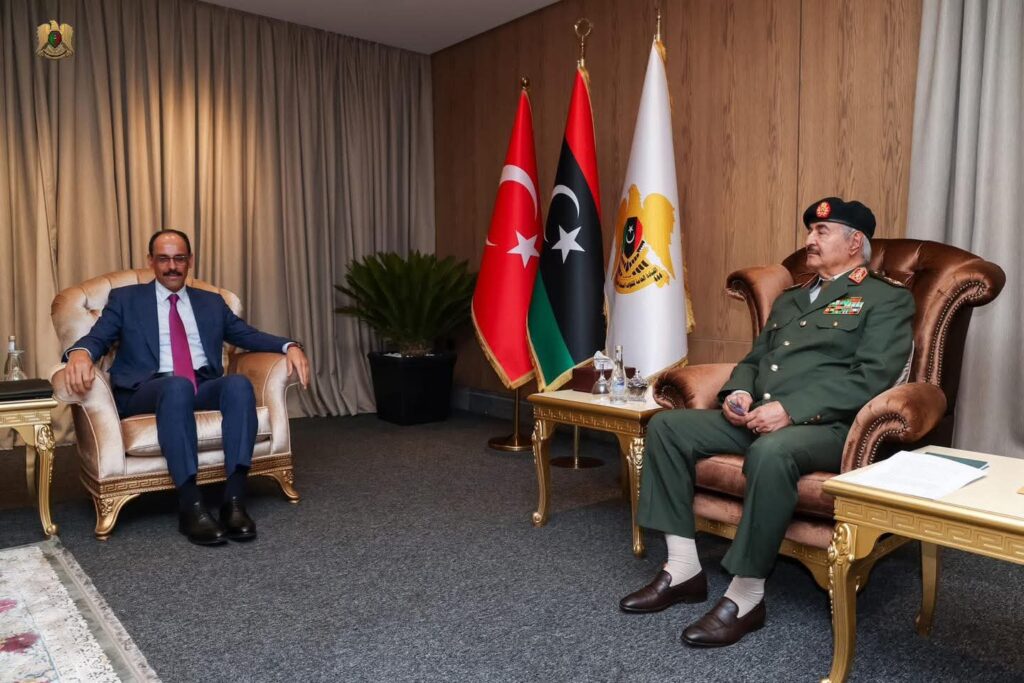
Turkey’s intelligence chief met on Monday with the commander of eastern Libya’s armed forces in Benghazi as relations improve between Ankara and the rival authority that controls the country’s east.
The talks between İbrahim Kalın, head of Turkey’s National Intelligence Organization (MIT), and Field Marshal Khalifa Haftar came as Libya’s Tobruk-based House of Representatives prepared to debate ratification of a 2019 maritime boundary agreement with Turkey. That accord, signed with the internationally recognized government in Tripoli, was denounced at the time by Haftar’s camp but gave Turkey a foothold in its energy dispute with Greece and Cyprus in the eastern Mediterranean.
The Benghazi meeting, which also included Libyan National Army officials, focused on bilateral relations and regional security, according to both sides. Kalın also met Haftar’s son, Saddam, recently promoted to deputy commander of the Libyan National Army. Their talks touched on intelligence and security cooperation.
The meetings came after the docking of the Turkish naval corvette TCG Kınalıada at Benghazi port on August 20-21. Turkey’s defense ministry said the ship’s visit included joint exercises with Libyan patrol boats and talks between Turkish and Libyan delegations under the slogan “One Libya, One Army.”
The Turkish team was led by Brig. Gen. İlkay Altındağ, accompanied by Turkey’s ambassador to Libya and the consul general in Benghazi and met with Saddam Haftar during the port call.
For Turkey, the engagement represents a shift from backing only Tripoli’s Government of National Unity. Analysts say Ankara now seeks to be a player accepted by all power centers in Libya, driven by instability in Tripoli, opportunities for investment in the east and the desire to protect maritime claims in the Mediterranean. The policy reflects Turkey’s broader regional normalization strategy with Egypt, the United Arab Emirates and Saudi Arabia.
For Haftar, who once accused Ankara of military intervention, the change is rooted in pragmatism, according to analysts. His military campaign to seize Tripoli stalled, Russian backing has waned since the Ukraine war and regional allies are more cautious. That has left him looking for new partners. Turkey offers not only military training and weapons but also political connections in the region.
If Haftar’s House of Representatives approves the 2019 maritime memorandum, analysts say it would strengthen Turkey’s legal position in the Mediterranean, end the agreement’s domestic legitimacy problem inside Libya and bolster Ankara’s push to break regional isolation. Greece and Cyprus fiercely opposed the deal when it was signed, while the United Nations registered it in 2020.
Turkey and Haftar’s forces remained on opposite sides for nearly a decade. Ankara backed Tripoli during Haftar’s 2019-2020 assault on the capital, and Haftar branded Turkey an occupier. Relations began to thaw in late 2023, when the speaker of the eastern parliament visited Ankara, followed by multiple visits from Saddam Haftar to Turkish defense fairs and military meetings. Turkey reopened its consulate in Benghazi in 2024, and earlier this year Haftar’s parliament formed a committee to examine the maritime deal.