


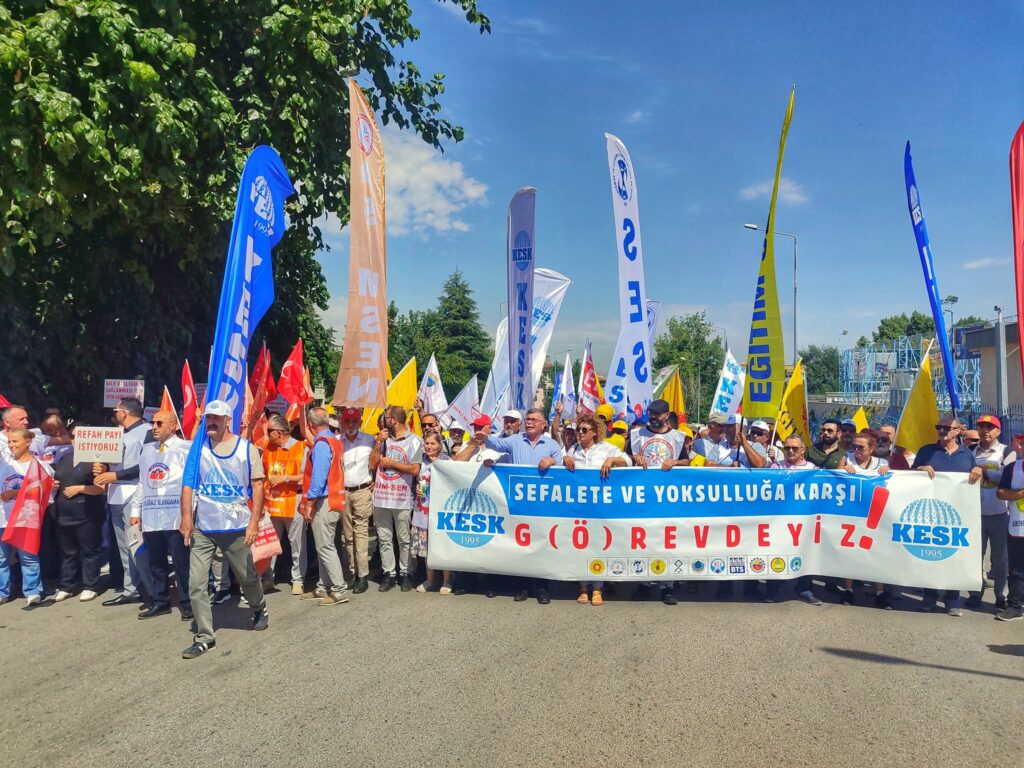
Turkey’s collective bargaining talks with civil servants ended in deadlock this week, sending the dispute between the government and the Civil Servants Trade Union (Memur-Sen) over 2026–2027 pay raises to the Public Servants Arbitration Board for a binding decision, BBC Turkish service reported on Wednesday.
The negotiations, which began on August 1, affect nearly 6.5 million civil servants and retirees. Labor Minister Vedat Işıkhan presented the government’s third and final offer on Monday, which included a raise of 11 percent for the first half of 2026 and 7 percent for the second, followed by 4 percent increases in both halves of 2027. The package also included a TL 1,000 ($24.40) increase in base salaries.
Memur-Sen rejected the offer, with its chairman, Ali Yalçın, saying it was “impossible to accept.”
“The collective agreement talks ended in deadlock. The proposals are not at a level that would ensure wage balance or establish labor peace,” Yalçın also said in a new statement on Wednesday.
According to the BBC, the parties now have three days to appeal to the Public Servants Arbitration Board, an 11-member panel whose ruling will be final and carry the force of a collective bargaining agreement.
Confederation of Public Sector Trade Unions (KESK) Co-chair Ayfer Koçak said they did not expect a different outcome if the dispute is referred to the board, arguing that it only serves to “tie the hands of workers.” She added that because the board’s composition is determined by the government, the final outcome never goes beyond the amounts already offered by the authorities.
Memur-Sen slams rumored probes into nationwide strike
Memur-Sen, Turkey’s biggest civil servants’ union, has denounced claims that civil servants who joined a nationwide strike earlier this week will face investigations, calling the move “unlawful” and warning it could spark further protests, according to a report by the Anka news agency on Tuesday.
The union said on Tuesday it had received reports that disciplinary investigations would be opened into members who participated in Monday’s work stoppage, which was staged across all 81 provinces to protest the government’s latest wage offer.
“Such unlawful, unacceptable and reckless initiatives will never be tolerated,” the union said in a statement. It warned that targeting strike participants despite Constitutional Court rulings recognizing union actions as part of the right to organize amounted to a violation of freedoms guaranteed under Turkish law.
“… Launching investigations, imposing disciplinary penalties or subjecting public employees who joined the action to similar sanctions or threats of sanctions would open the door to other protests and reactions that would overshadow the August 18 action and spread across Turkey,” the statement added.
Memur-Sen further stressed that union-organized actions cannot be treated as absenteeism, recalling Constitutional Court precedents that overturned disciplinary penalties in similar cases. The union announced it would file criminal complaints with public prosecutors against officials who open investigations or impose sanctions on members, accusing them of committing the crime of obstructing trade union rights.
Monday’s strike came after the government made its second offer in the 8th Term Collective Agreement negotiations, which was rejected by the public employee confederations for being unworthy of negotiation.
It was organized by a coalition of public sector unions, most prominently KESK, which gathered with its affiliated unions in front of the National Library in Ankara before marching to the Labor and Social Security Ministry. KESK was later joined by the United Public Workers Confederation (Birleşik Kamu-İş) as well as several other unions, including BASK, DMK, HAK-SEN, YURT-SEN and ASİM-SEN.
Although Memur-Sen and the Turkish Public Workers Labor Union (Kamu-Sen) are known for their close ties to the government and did not take part in the joint demonstration, both held separate protests.
Memur-Sen demands an 88 percent raise for 2026 and 46 percent for 2027, figures that include six-monthly raises of 25 and 20 percent in 2026 and 20 and 15 percent in 2027, along with increases to the base salary — a 10,000-lira rise plus a 10 percent prosperity share at the start of 2026 and a 7,500-lira rise at the start of 2027. The union also sought a monthly 2,925 lira collective agreement bonus, a separate allowance given on top of salaries as part of collective bargaining, and 17,600 lira in housing support, in addition to other allowances.
A prosperity share is a type of payment made in addition to employees’ regular wages, typically intended to compensate for losses in purchasing power caused by inflation or economic crises. This payment is designed to improve workers’ living standards and ensure a higher level of well-being.
The developments follow a series of strikes by the Confederation of Turkish Labor Unions (TÜRK-İŞ), Turkey’s largest labor confederation, in late July after failing to reach a deal with government employers over wage increases.
According to TÜRK-İŞ’s July figures, the hunger threshold in Turkey, the amount a family of four needs to spend on food for a healthy and balanced diet, stood at TL 26,413 ($665), exceeding the current monthly minimum wage of TL 22,104 ($574). The poverty line, which includes additional expenses such as housing, transportation, clothing, education and healthcare, was calculated at TL 86,036 ($2,167).
Turkey is known for its relatively high percentage of the workforce making the minimum wage. Labor unions estimated that roughly half of all workers earn a wage similar to the minimum wage.
The Turkish economy has been plagued by high inflation, currency depreciation and a widening wealth gap. The Turkish lira has ranked among the worst-performing emerging market currencies in recent years, largely due to economic and monetary policy under the government of President Recep Tayyip Erdoğan.
Earlier this month the Turkish Statistical Institute (TurkStat) reported an annual inflation rate of 33.52 percent for July. However, the independent Inflation Research Group (ENAG) estimated annual inflation at 68.68 percent and a monthly rise of 3.05 percent, nearly double the official figures.