
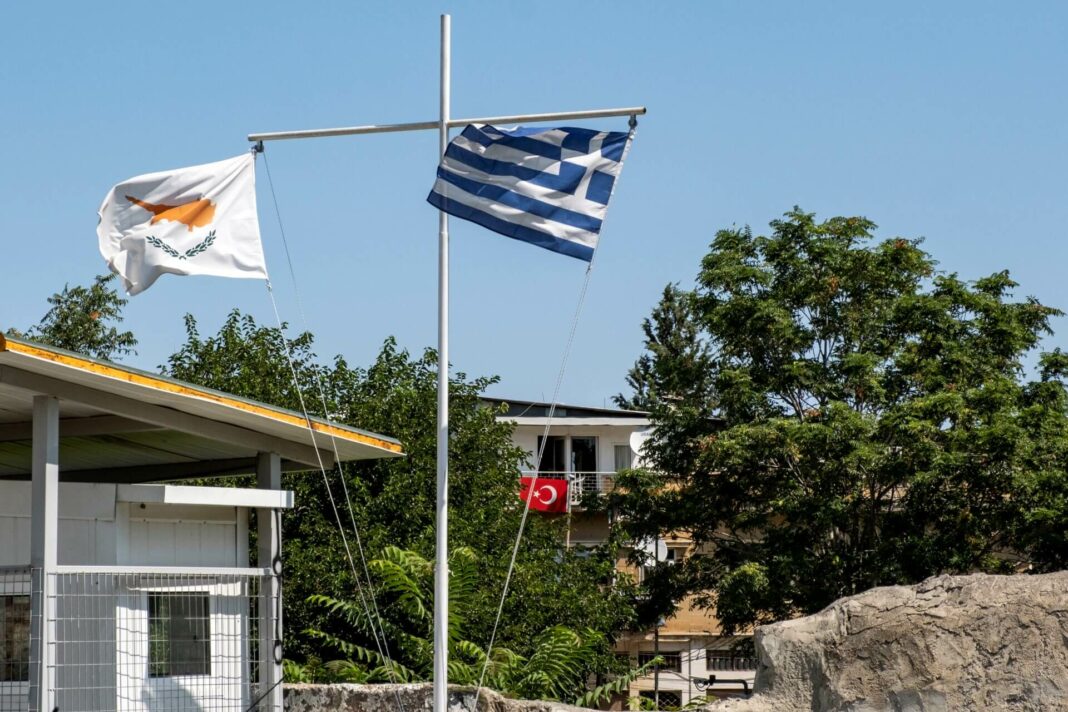

Turkish Cypriot leader Ersin Tatar said Thursday that formal negotiations to resolve the Cyprus issue will not resume unless the sovereign equality and equal international status of Turkish Cypriots are recognized, Turkey’s state-run Anadolu news agency reported.
Cyprus has remained divided since 1974, when Turkey conducted a military intervention following a Greek-backed coup aimed at unifying the island with Greece. The Turkish Republic of Northern Cyprus (KKTC), declared in 1983, is recognized only by Turkey. The Republic of Cyprus, based in the south, is an EU member state.
“We obviously, in the last four years, have consolidated our new policy that unless our sovereign equality and equal international status are recognized, we will not resume formal negotiations for the resolution of the Cyprus problem,” Tatar told reporters at a news conference at UN headquarters in New York after a two-day informal meeting on the Cyprus issue.
Tatar added that Turkish Cypriots view these principles as their inherent rights, emphasizing that any future talks must reflect the realities on the island and treat both sides with equality and dignity.
The expanded informal talks, convened by UN Secretary-General Antonio Guterres from July 16 to 17, concluded without breakthroughs on key confidence-building measures. These included the proposed opening of four new border crossings — checkpoints that allow movement between the Turkish Cypriot north and the Greek Cypriot south — and the creation of a solar energy plant in the UN-patrolled buffer zone. Guterres, however, reported progress in other areas and announced plans for further meetings to maintain momentum.
The format followed a March session in Geneva, where participants had agreed on six cooperation initiatives to build trust between the communities. Participants included Tatar, Greek Cypriot leader Nikos Christodoulides and representatives from the guarantor powers — Turkey, Greece and the United Kingdom — along with UN officials.
Guterres described the meetings as “constructive” but acknowledged that stronger outcomes had been hoped for, warning that “there’s a long road ahead.” He said “meaningful progress” was made on de-mining efforts, with only technical details remaining before a full agreement. De-mining is part of broader efforts to remove explosives left from past conflicts and improve civilian safety across the island.
The parties also agreed to move forward on a number of other areas of cooperation: establishing a civil society advisory body, exchanging cultural artifacts, monitoring air quality, addressing microplastic pollution, creating a youth-focused technical committee and restoring cemeteries.
Discussions on new crossings stalled due to disagreements over proposed routes. Tatar accused the Greek Cypriot side of seeking paths through the buffer zone for what he described as “military or territorial purposes,” which he said the Turkish Cypriot side could not accept. Christodoulides countered that his administration had approved Turkish Cypriot proposals for crossings at Haspolat (Mia Milia) and Akıncılar (Louroujina) but had received no reply on Greek Cypriot proposals for Erenköy (Kokkina) and Piroi (Gaziler), citing Turkish military presence as an obstacle.
On the solar energy project, Tatar said Greek Cypriot demands for exclusive control over energy distribution had hindered progress. Broader energy cooperation also remains unresolved.
Christodoulides described the outcome as a “small but important step” toward restarting formal talks and thanked Guterres and the guarantor powers for their continued support. He said greater political will was needed to move forward.
Tatar also voiced concern over developments since the Geneva meeting, pointing to what he called a Greek Cypriot campaign involving property-related arrests that have raised fears among Turkish Cypriots. These arrests involve land claims dating back to before the island’s division in 1974. Turkish Cypriots say they risk detention when crossing south or traveling abroad due to arrest warrants linked to real estate transactions in the north. Greek Cypriot authorities say these actions are in response to the growing construction of villas and apartments on what they consider to be unlawfully occupied land.
Turkey’s foreign ministry echoed Tatar’s concerns, stating that disagreements over crossings and energy blocked progress and reiterating support for cooperation based on the principle of two equal entities on the island.
Guterres announced plans for a trilateral meeting with Tatar and Christodoulides during the UN General Assembly’s high-level week starting September 9. Another expanded informal session is expected later in the year, likely following Turkish Cypriot leadership elections on October 19.
Nine official border crossings currently operate along the 180-kilometer (110-mile) buffer zone, allowing thousands to commute daily for work, education and medical needs since their gradual opening began in 2003. UN-mediated reunification efforts have failed multiple times, including in 2017 in Switzerland. In 2004 Greek Cypriots rejected a UN reunification plan that had been approved by Turkish Cypriots in a referendum.
The buffer zone, patrolled by UN peacekeepers under a 1964 mandate, includes restricted areas used for de-mining and potential joint initiatives. There have been growing calls for more crossings to ease congestion and enhance community interaction in less accessible regions.