

Adem Yavuz Arslan*
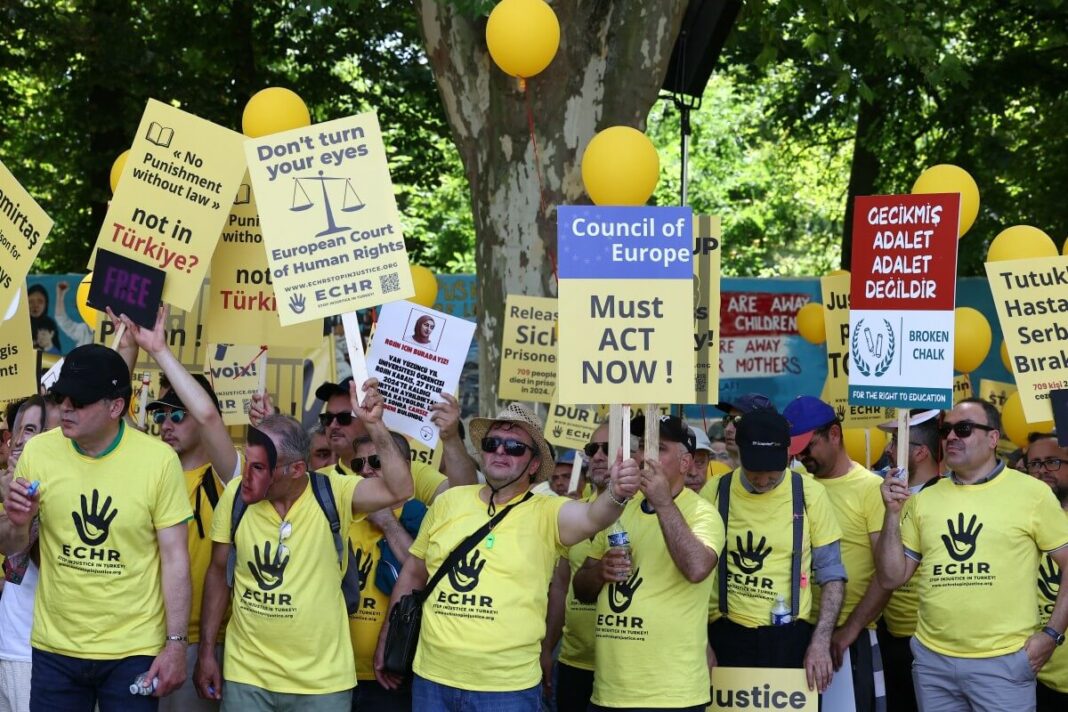
This week the European Court of Human Rights (ECtHR) issued another series of judgments against Turkey, which raised the number of individuals whose rights have been officially recognized as having been violated by the Turkish government to 3,386 since a coup attempt in July 2016, according to legal experts following these cases. Among them are 1,225 former judges and prosecutors, swept up in the massive purge that followed the failed coup. This purge has become emblematic of President Recep Tayyip Erdoğan’s authoritarian transformation of the Turkish state.
But these figures represent just the tip of the iceberg. They only include the cases that made it through the long and arduous journey to Strasbourg. Thousands more applications have been dismissed on procedural grounds or were never filed at all, blocked by fear, financial constraints or a deepening sense of hopelessness in the Turkish justice system. Taken together, these cases offer a grim portrait: a country where the rule of law has become the exception rather than the norm.
Strasbourg’s unintended role
The ECtHR was never designed to serve as a mass tribunal for authoritarian abuses. Its mandate is to address violations of individual rights, not to compensate for the collapse of an entire judicial system. Yet in Turkey’s case that is precisely what it has become. As of 2024, one in every four applications pending before the ECtHR originates from Turkey. Following Russia’s expulsion from the Council of Europe in 2022, Turkey has effectively assumed its place as the council’s top human rights violator.
A legal system in collapse
In 2023 alone, the ECtHR issued 78 rulings against Turkey, nearly all of them related to violations of core democratic rights — the right to a fair trial, protection from unlawful detention, freedom of expression and freedom of assembly and association.
Many of these cases are rooted in post-coup emergency decrees through which some 130,000 public sector employees, including judges, prosecutors, academics and teachers were dismissed or detained without due process as well as the dismissal of more than 24,000 military officers. The ECtHR has repeatedly ruled that these mass purges constitute not merely isolated violations but structural and systemic violations of the European Convention on Human Rights.
The faces of injustice: Kavala and Demirtaş
Two landmark cases highlight the depth of Turkey’s judicial deterioration more vividly than any statistic: Osman Kavala and Selahattin Demirtaş. Kavala, a philanthropist and civil society leader, has been imprisoned since 2017 on charges widely seen as politically motivated. Demirtaş, the former co-leader of the pro-Kurdish Peoples’ Democratic Party (HDP), has been held in pretrial detention since 2016, despite multiple court orders for his release.
In both cases the ECtHR ruled that the detentions were intended to silence political opposition and civil society, not to uphold justice. The court demanded their immediate release. Ankara refused. Instead of complying, the Turkish government attacked the court’s credibility and accused it of political interference.
This defiance prompted the Council of Europe to initiate infringement proceedings, a rare and serious measure previously taken only against Vladimir Putin’s Russia.
Strasbourg as a last resort
For thousands of Turkish citizens, the ECtHR represents the last, fragile hope for justice. But even here, the path is long and uncertain. Cases take years to resolve. And even when applicants win, the Turkish government often fails to comply with the court’s rulings. In this sense, the ECtHR has become a symbol of both justice delayed and justice denied.
Still, Strasbourg matters. Not only as a judicial venue but as a moral mirror, a place where the international community can witness, in legal terms, the erosion of democracy and the rule of law in Turkey.
Denial, deflection and isolation
Rather than confront this reflection, Erdoğan’s government tries to shatter the mirror. Turkish officials routinely dismiss the ECtHR as biased, accuse Europe of hypocrisy and cast human rights as tools of Western meddling. This narrative may resonate domestically, but it further isolates Turkey on the international stage.
Importantly, compliance with ECtHR rulings is not optional. It is a core obligation of membership in the Council of Europe. By ignoring the court’s judgments, Turkey is not only courting legal sanctions, it is jeopardizing its place within the European democratic and legal framework.
A mirror that must not be broken
The ECtHR has held up a mirror to today’s Turkey, and the image it reflects is troubling. It shows a judiciary stripped of independence, dissent criminalized and thousands imprisoned not for acts but for ideas.
The question is no longer whether Turkey is violating human rights. That has been established. The real question is: How long can the Council of Europe tolerate a member state that systematically defies the rule of law? Turkey doesn’t need to break the mirror.
It needs to face it.
*Adem Yavuz Arslan is a journalist with over two decades of experience in political reporting, investigative journalism and international conflict coverage. His work has focused on Turkey’s political landscape, including detailed reporting on the 2016 coup attempt and its aftermath, as well as broader issues related to media freedom and human rights. He has reported from conflict zones such as Bosnia, Kosovo and Iraq, and has conducted in-depth research on high-profile cases, including the assassination of Turkish-Armenian journalist Hrant Dink. Arslan is the author of four books and has received journalism awards for his investigative work. Currently living in exile in Washington, D.C., he continues his journalism through digital media platforms, including his YouTube channel, Turkish Minute, TR724 and X.